Wednesday, November 8, 2017

Removing the Filters on Our Gaze: Finding Samadhi in Practice

Samadhi is the state of ecstasy or the pinnacle of yoga. This is not achieved by putting your foot behind your head, but by dedicated practice. The best definition of samadhi I’ve ever received is this: samadhi is achieved when all of our filters are removed. By that, I mean, everything that has shaped you; your education, gender, upbringing, whether you live in a rural area or urban, the color of your skin, your family relationship, if you have allergies, if you work with physical or health considerations, whether you have been sexually assaulted…and on and on. Most yoga practioners do not find samadhi.

These filters are important because they shape our ego and ego is necessary for living. Without ego, you would just be a blob. Ego reminds us to bathe, use our manners, speak, eat, make an effort. Ego is also why our species thrive, it makes us adaptable by creating ways to live more comfortably.

I invite you to imagine for a moment all the ways in which you identify yourself. Maybe begin with gender or race, think about how your education or lack-there-of has shaped you, where you grew up and the make-up of your family (were both parents present or were you raised in a single parent household?). All of these things molded you into the person you are.

Begin to add other things, like the company you keep or what type of occupation you chose.

Now add the scary; the close-calls that could have gone the other way, the event that took place shortly after you left…whatever it may be. And maybe for you it doesn’t have to be imagined, maybe you are someone who is working with your own experience every day. Maybe you have experienced the scariest thing you think you ever can experience and allow yourself to acknowledge it.

Now that you have taken a moment to consider all the ways you have been shaped as a person, try to remove them. See if you can strip them all away in this very moment. Many, if not all of you will say, ‘I cant.’ Its extremely difficult to force yourself to forget and clear the mind in this way. We need tools, guidance and teachers in order to navigate all the folds of our makeup. Even then, the work of unworking, can take years.

The yoga practice of asana is an opportunity to get brief glimpses into what the removal of filters could look like. Asana is your initial tool for moments of space in both body and mind. As the body moves through space, your attention shifts away from the clockwork of the future and the past and settles into the present space-eliminating for moments or minutes thoughts that otherwise occupy that space. And while the long term work of samadhi is extensive, I invite you to savor the glimpses within regular practice.

Wednesday, October 25, 2017

Loving Yourself: the power of considering contentment

I have found such joy in the simple things;
A plain, clean room, a nut-brown loaf of bread,
A cup of milk, a kettle as it sings,
The shelter of a roof above my head,
And in a leaf-laced square along the floor,
Where yellow sunlight glimmers through the door.

I have found such joy in things that fill
My quiet days: a curtain’s blowing grace,
A potted plant upon my window sill,
A rose, fresh-cut and placed within a vase;
A table cleared, a lamp beside a chair,
And books I long have loved beside me there.

Oh, I have found such joys I wish I might
Tell every woman who goes seeking far
For some elusive, feverish delight,
That very close to home the great joys are:
The elemental things-old as the race,
Yet never, through the ages, commonplace.

~Grace Noll Crowell

Regularly I have clients approach me about anxiety, agitation, how they are searching. They are looking for happiness, positivity, joy, etc…but the one word they never use is contentment. If we were looking at a sliding scale, as Tim Ferriss discusses, the opposite of happiness is boredom. I disagree, I think the opposite of happiness is indecision. Neither places can a person live in at all times, because the greatest tool being overlooked is contentment. And its contentment that we as a society are in constant battle with. The closest anyone has come to labeling contentment to me has been by using the word ‘peace’.

Contentment is both the gateway and the destination.

The Paradox of Choice, is when a person is presented with so many options, they are less satisfied with the choice they do make because they are not sure the choice they made was the best one. With so many options out there, how do you know you made the best choice? In truth, you don’t. As the internet brings the world closer together, people doubt many of their decisions: Did I buy the best vacuum? Did I pick the best thing on the menu at the Cheesecake Factory? What to watch on Netflix? Am I with the right person?

Please don’t get me wrong, Im not asking you to consider ‘settling’ for the first person/job/vacuum that comes your way. Nor am I asking you to seek happiness within an unhealthy environment. I’m suggesting you pause. Just stop, before you see something you ‘need’, before you see someone who might be your soulmate, and just take a look at the place you’re in.

In this moment, can you find contentment if nothing changed? Not your job, not your home or your relationship status? Can you be ok within this moment if everything froze?

Now, the expectation of everything staying the way it is, isn’t realistic. We are forward moving creatures on a planet that doesn’t stop moving. So freezing can only be an idea as opposed to the reality. But the suggestion of it, the pause it creates in you to consider. That’s the moment I want you to think about.

If you’re chewing on the idea of contentment in this moment with some peace, allow yourself to come back to this question when you feel chaos coming back into your life.

If you’re feeling a twinge of, ‘I’ll be ok, but this one thing has to happen first’ Im going to ask you to consider if it doesn’t and how you will respond to the alternative. Again, considering contentment.

If the idea of nothing changing sends you into a panic, grab a pen a paper and begin to write down those fear-zones. Write them all down, but keep them in the present. If you find your language jumping into the future, dial it back to now. What if you stay in the same house, same job, same car, etc… And with each area, can you focus on each item and find some contentment within each of those spaces?

Finally, look at yourself. Just as you are. Don’t focus on places in the body that are uncomfortable, but look at you as a whole. Can you look at yourself without needing to change anything? Notice when the language moves into the future, or into the past, you’ve begun to compare. Can you keep the internal dialogue present?

Loving yourself implies surrounding yourself with boastful energy, while contentment implies settling. If you truly look at what those phrases are asking of you, they are asking for you to take away comparison. They are asking you to remove your inner ‘mean girl’ and find the person you are when nobody’s looking.

Looking for some more ways to work on self-love, acceptance and contentment? Join us at the studio Sunday, November 5th as we host Amber Karnes of Body Positive Yoga, as she leads the ‘Radical Self-Acceptance Workshop’. Sign up at www.mainstreetyoga.com/workshops.

Wednesday, October 11, 2017

I didn’t get into yoga to lose weight: an essay on finding True North

 I'm not in the ‘get skinny’ business. Nor did I start practicing yoga to lose weight, if I had, I’d be a size 2.

I began my practice at first, because I felt as though I had gotten lost. My moral compass and energy felt chaotic and I was beginning to spiral out of control. At the time I didn’t know what anxiety really was, but it had taken hold of me and I was suppressing it with alcohol.

At the time, I remember I was searching for the air I used to know. The clean fresh air that had a distinct flavor which would charge every cell in my body. I didn’t know how to describe it at the time, but I knew it when I felt it. For those moments, I caught a glimpse of myself trying to reemerge. My own duality of the self, realized. I wasn’t terribly proud of either version of me on their own, but I was trying to reconcile each side into a framework of a person I felt I was becoming-someone I felt I could be proud of, who lived with integrity.

Yoga had been on the outskirts, strumming this chord inside of me, beckoning to that previous version of myself. I would observe this pattern, as though I was a feral cat, and yoga a place of solace, circling me trying to lead me home. I was afraid of what yoga would show me and for a couple years, I just let it circle the perimeter.

In retrospect, I know why I was so hesitant to approach yoga. It was going to tear me open in a way I would least expect it! It was going to expose the underbelly of myself and show me how I was regularly lying to myself, hurting myself and not listening to my own set of truths. I just wasn’t ready to hear all of that at the age of 21 or 22. But at 23 when a series of events uprooted my entire life, I fell into yoga’s arms; much like many desperate people fall into religion. I was naked and terrified and out of options.

There are times I hate my practice, I cry or avoid it. I sometimes get mad at yoga-as though it had offended me. And yet, yoga lovingly continues to point out my own silliness. How I can get in my own way and when I’m being a hypocrite. It shows me how to honor myself and others without being rash or presumptive. It gives my soul a sanctuary to thrive.

Yesterday, as I was leaving the store I caught the air that first drew me toward my practice. My body felt its charge and was completely awake and aware. Each time it finds me I picture the orchard where I grew up. I can hear the wind blowing through the evergreens to the west. Their song so distinct and intense; yet soothing. In these moments everything stops. The wind speaks to me and I must pay attention to understand its message.  Its those moments where I am reminded of my ‘True North’. The inner compass of my soul speaks to me and time slows down. If I didn’t want to drink in the air so badly, I would probably hold my breath, but I want to experience the wind from all sides.

I, by no means, judge or condemn those who practice yoga for the physical benefits, but I knew long ago-physical yoga wasn’t what I was looking for. I needed to rediscover something within myself that I had been overlooking. Stop allowing other people to dictate my True North for me and listen to the person I had been smothering within myself.

Tuesday, September 26, 2017

Update your Mantra: Say yes to you!

I was recently talking to a friend of mine about what pulls people away from making regular healthy choices and decisions that can ultimately change their life for the better. She had been telling me about a conversation she had with a client who came into their appointment, sat down, and started rattling off all the things going on in her life, how stressed she was and how its impossible for her to maintain her goals. Everything the client listed was relatable: work, family, extracurricular activities, school obligations, you name it.

As shes telling me this story, Im quickly identifying with her client and all the things I don’t do because of filling my time with other, seemingly more important, things. Im not alone, we all work to morph ourselves and our schedules to accommodate everything that comes our way. Even when it’s a simple event, like going to dinner with friends.

The funny thing is, by participating in everything we possibly can, our intention is not to cause harm, but the opposite! We are trying to make everything work, keep everyone happy or satisfied and live the biggest and most glorious life we can! Right?

But what are we sacrificing in the process?

The first rule of yoga is ahimsa, or nonviolence. Cause no harm to others, but also to the self whether it be through words, actions or thoughts. Adding stress to the self is another way you cause harm. It’s the carbon monoxide of our daily lives because stress is an invisible toxin creeping into our bodies and minds causing great damage.

The third rule of yoga is asteya, or nonstealing. We steal from ourselves and others constantly. When we deprive ourselves of adequate nutrition, sleep, water and time, we are sacrificing the opportunity to be healthy, fully present, mentally sharp and coherent. We steal from our families and friends by being late when we over schedule, snapping at our loved ones and dumping our chaotic energy on those around us.

Here are a few questions you can ask yourself to determine if you are caught up in what I call the ‘Epidemic of being busy’.

  1. If something gets cancelled on you, do you breathe a sigh of relief?
  2. When someone asks you how you’ve been, do you always say, ‘Busy’?
  3. Does the idea of shutting the ringer off on your phone for an entire day seem ridiculous or cause anxiety?
  4. Is frozen pizza the back-up plan to a real dinner?
  5. Do you have a bedtime and bedtime routine?
  6. Are you perpetually 10 minutes late to everything?

As my friend is listening to her client go on about her stressful week, she quietly picks up a piece of paper, jots something down and waits for her client to pause. Finally, her client, finishes and leans back into her chair. My friend says to her client, ‘I wrote down something for you to try.’ She turned the paper over and on it, in big letters was the word, ‘NO’.

I invite you to consider No as an option as you move forward through your week. Allow No to be an option for you to create space and exercise self-care. Invite No in, so you can be a better parent, partner or friend. Use No so you can say yes later.

Wednesday, July 26, 2017

Building Trust in Yourself: Creating Inner Dialogue to Support the Self


Can you trust yourself?

This phrase has been ringing in my head for the last few weeks. Every now and again, I read something that resonates with me at the exact moment I need it. When I was in my 20’s I read Stephen Covey’s, The 7 Habits of Highly Effective People, and the way he articulated ‘integrity’. Prior to that, I always valued my honesty, but how honest can you really be if you’re not following through on the things you say you’re going to do? That’s just a lie in sheep’s clothing.

At the end of my 20’s, I was working a job that I hated with a boss who berated all of his employees for the fun of it. Then I read Einstein’s quote, ‘Everybody is a genius. But if you judge a fish by its ability to climb a tree, it will live its whole life believing that it is stupid.’ It made me appreciate the things I did have to offer, and also to stop listening to my boss.

And a few weeks ago I was reading Deborah Adele’s The Yamas & Niyamas and in her chapter on satya (truth), she describes how we tell ourselves lies all the time. We lie to ourselves about how much time we have, what our capacity for helping can be, what we are going to do for ourselves (go to yoga, meditate, eat better, etc.), and then she asks, ‘Can you trust yourself?’

Well, shit. If she were an evangelist passing the plate, in that moment she would have had all my money.

I started thinking about all the ways I lie to myself and let me tell you, the list had some heft to it. Much like weight, small indulgences compound to bigger issues over time and leave the person feeling as though goals are frivolous. Some of the items were small, like not leaving dirty dishes in the sink. While other goals were things I have been struggling with for some time, like running.

And so, I started to look at myself to see what small changes I could make.

First, I began to take notice of the little things that were out of place. Instead of leaving them there, I would make more of an effort to put things back after I used them and remember to, for example, grab the magazine and throw it in the recycling bin when I was going into the kitchen. Now, my house is by no means the pillar of cleanliness, but more often, I am coming into places that have not been tarnished by my last visit.

Second, I started emptying the clean dishwasher regularly. We never really had a problem putting dishes in it when it was empty, but putting the dishes away was always a much avoided chore. Now, my kitchen stays tidier.

Third, I bought a robotic vacuum. I have a dog, who I love, but he sheds and quickly after vacuuming do the tumbleweeds-o-fur creep out. Its very challenging to work from home and feel as though you need to be sweeping all the time. I figure, with the time saved between distraction and effort, the little robot guy will pay for himself in no time (even if my dog hates the thing).

Finally, I started swimming. I have been trying to create a cardio routine for years. Being a yoga instructor, I get a lot of strength and stretch, but very little cardio. I’ve tried different activities like Zumba or cycling, but they’re not my bag either.  I have never really taken to running, even if I admire those who do it. It always seems like something I would enjoy, but I physically feel terrible after running. I love to walk, but the type of walking I would like to do, still takes a lot of time and planning. I needed something that would truly let me checkout. And it dawned on me, I love to swim, always have. Its relaxing, rewarding and doesn’t make my body hurt in all sorts of ways. I found a suit I could do laps in and began getting up early to go to the local pool. I love it. And after a few days, I figured out there were other things taking me away from running, walking and cycling…I don’t like all the distractions. The tvs, loud music, the people milling around. I like the quiet of the water and how the only technology in the room is the clock. I can just move through the water focusing on my form and my breath and get lost in the quiet.

So am I really telling you by doing the dishes, you can strengthen your yoga practice? Yes! The yoga lifestyle is meant to be lead outside of the studio. When you practice activities that require presence and then you begin actively reminding yourself to notice when the action is missed-that is precisely what your teacher keeps trying to get you to do every time they ask you to ‘check-in’. Practicing the theory isn’t limiting you to your asana practice, but by how you take your practice out into the world and also how you treat yourself.

So now Im going to ask you:

  • Can you trust yourself?
  • What kind of lies are you telling yourself each day? Big or small, begin to make a list of what you’re working to avoid.
  • Next, ask yourself to pick the smallest and most task oriented lie. Something you can take action on quickly. Just like with compound weight gain or money accumulation, its best to start with the most tangible. Every day, make the effort. Give yourself a week to commit to this goal. You just have to do the one thing each day.
  • After your week (maybe two), with the success of the first task, you may have already been thinking about what you could easily add to this. Go with what’s easy. Allow the energy to build in these small steps.
  • Keep asking if you can trust yourself. Observe whats keeping you from saying yes. Respond, without negative commentary. Allow the answers to provide new insight on what is getting in the way of your yes.

The reward is your success and consistency. Eventually, you will begin to crave the reward of completion.

Wednesday, July 12, 2017

Pounding yourself into submission: Yoga and Pain

Let me lay out a generic setting for you. Something that has played out many times in my few years of teaching.

I’m out with my husband and we come across some people he knows from [pick a place]. I have never met these people before and after the formal introductions, they ask me what I do for a living. With trepidation, I tell them Im a yoga instructor. Almost immediately, Im informed at how they cant do yoga, they tried the P90X version and were sore for a week or they went to a class once and everything they did hurt. I stand there and politely nod as they tell me their yoga woes. I don’t counter with some sort of sales-pitch, I don’t rattle off statistics or wellness magazine quotes. I just let them say their peace and we move on to the next topic.

In these scenarios, I know the individual isnt trying to talk me out of my profession or insult me in any way. I have always felt as though this was their way of trying to relate to me and Im fine with that. I honestly appreciate the effort, but the by-product is there often is a theme to their dialogue and the theme is: PAIN.

PAIN IS A SIGN THAT SOMETHING IS WRONG!Yoganand Michael Carroll once said (and Im paraphrasing), ‘a pain-free yoga practice will develop infinitely faster than a practice with [any] pain.’ He said this because the first rule of yoga is ‘non-violence’ (Ahimsa). But also because pain is a sign that something is wrong. I repeat:

In the epidemic of being busy, trying to diet (see Radiance’s Odyssey article) and creating an illusion of having ourselves together when really most of us are hanging on as best we can-our society has lost patience for our own bodies and the messages they are sending. If it hurts, it will go away; if we’re sick, we’ll move on despite it; and if it breaks, we’ll get a new one (even if it’s a body part!). But over time, without proper attention, the pain comes back more often, the sickness doesn’t shake and the body part…well, to replace it comes at a price of both time and money-not something everyone has in excess.

I like to think I regularly tell my students that pain is bad and I’ve had many students tell me they appreciate a pain-free message. So when Im standing in front of a room of students and there is a person trying to cram their body into position after position, I cant help but to scratch my head and wonder why they are spending their money to connect with a body they believe they should have, trying to make their body do something they think it should do, as opposed to honoring their true container. I want to stop the class and pull the student aside and tell them, ‘that puzzle piece doesn’t fit, stop pounding it into the board!’

Somewhere this student and the acquaintances from earlier were all were introduced to yoga with, ‘its wonderful, challenging and makes the body feel amazing,’ but they are deeply engrained with society’s message of: ‘challenge is hard and equals pain, but the pain will eventually feel good or go away, I promise’. This message has delivered so many times before to keep this idea alive! Colds wear off, cuts heal, hunger goes away at lunch time. And so they are all waiting for this promise to deliver, all the while going balls-to-the-wall. Because you’re not successful until you’re falling with exhaustion or pain. Gee, that sounds awful.

So I offer you this for the next class, workout or practice you are a part of:

  1. What if you practiced stopping right before you get into your fullest expression of the posture?
  2. Can you seek out the little whispers of pain and treat them with as much consideration as you would full-blown pain?
  3. Can you treat your body with the same amount of kindness and consideration you would request of a doctor or surgeon?

Try these three things in your next few practices and observe how the body responds. Allow yourself a little time to create these awarenesses and then carry them out into your day. Can you carry yourself without pounding your body into position?

Let me know how it goes.

Wednesday, June 28, 2017

5 Yoga Postures to Recharge the Body and Mind

Moving through the day has its share of ebb and flow. Within that time frame, you can encounter a lot of people, work and energy that needs moved around in the body. Simply sitting still can cause stiffness and a need for movement. Even as a yoga studio owner, get stuck in front of a screen for long stretches (pun intended).

At times, I get up, walk around, do laundry to step away for a moment. And yes, I even sneak in movements I know to shift things around in my body. So here are 5 yoga postures I practice (probably daily) throughout my day to bring a little stretch and movement in.

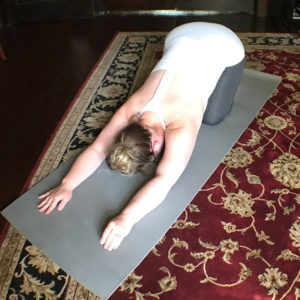
  1. Childs Pose (Balasana)

A great posture for soothing the mind and body, breathe deeply into it and allow the sensation to travel around the spine!

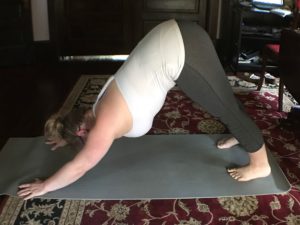
2. Downward Facing Dog (Adhomukhasvasana)

No need to have the heels touch the ground in this pose. Focus on pressing the earth away like a heavy piece of furniture. The power in this pose comes from the upper body, specifically around the ribs.

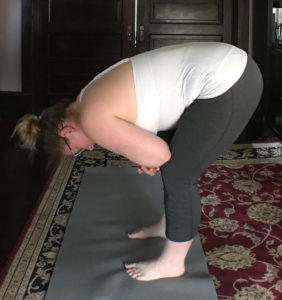
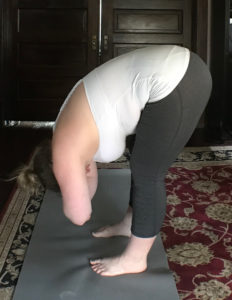
3. Standing Forward Fold (Uttanasana)

Hinging where the legs meet the pelvis, this deep fold stretches out the posterior (back side) of the body. An option if your back is exceptionally tight that day, is to rest your elbows on your needs. Rocking the hips from side-to-side can also help in either variation.

Alternative Uttanasana with elbows on knees

Clasp forearms so the arms dont swing and to support your shoulders

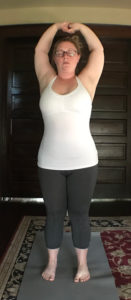
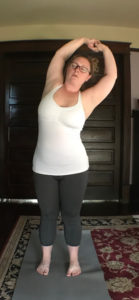
4. Pendulum Stretch

This posture is a variation of Standing Half Moon. It gets right into the side ribs on both sides of the body. Ground through the feet and pelvis maintaining a little bend in the knees for a more stable posture.


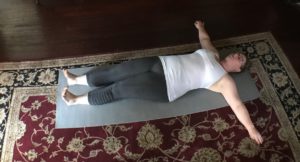
5. Abdomen Twisting Posture (Udarakarshanasana)

This posture have been a favorite for quite some time. I have yet to find a twist that feels as complete as this one! The key is to keep the shoulders planted in the ground and adjust the hips for a fuller twist. Also, dont reach the knee down, reach it toward the wall its pointing at for a better experience.

What are some of your favorite yoga postures for a quick energy boost! Leave them in the comments below!

Wednesday, June 7, 2017

Thinking of becoming a yoga teacher? Read this first


Sitting with two fellow yoga teachers (both of which have multiple 500hr certifications) having lunch, the conversation turned to one of a qualifying nature. By qualifying, I mean, ‘who the hell are we to tell people what yoga is?’ This conversation can at times become frustrating because of the long history of yoga and its many lineages, there are many opportunities for a counter-argument. But it leads the question, with so many yoga teachers out there, what really qualifies any of us to teach a practice that is so old and sacred?

When I need to sit with a question for awhile, I will occasionally take a walk or a drive. In my car, I decided on my answer to this idea rather quickly; I didn’t become a yoga teacher, I became a professional yoga student.  In 2005 when I took my first yoga class, I was a student of one degree, but in 2013 when I decided to invest money in order to participate in my practice in a bigger way-I became a different degree of student. When Im in front of a group of people leading them through a practice, Im sharing the pieces I have learned through both formal and informal study.

My work days are full teaching classes, of bills and organizing workshops, coordinating with teachers and students, but also, I have days that are spent studying books, concepts, postures, breathing and new ways to work with the body. Much like a professor whose job requires research, I spend much time keeping my information current and fresh for the clients and expansive for myself (and the clients too).

If becoming a yoga teacher is something you’re toying with as a possibility for your future, please know that all you’re committing yourself to is becoming a new type of student. You’re not required to teach for a living, but you are asked to expand your thinking. You’re invited to move through your experience with a different perspective. You’re invited to create an expansive space both within the mind and within what Getta Iyengar calls, ‘the body itself is a mini universe’.

I absolutely love what I do. I’m grateful for the opportunities as they have been presented to me and the opportunities I have yet to experience. Being a career student is something I could have never predicted for myself, but now, I don’t know who I would be without it. Three and a half years later and over 1000 hours of teaching experience has answered many questions I have had, but also has lead me to more questions. Some days that makes me want to throw up my arms, but most days, I remind myself that 3 years ago, I wouldn’t know what to ask to begin with.

Interested in becoming a professional student of yoga? Our next 200hour Training Program will begin in February of 2018. Click the Link HERE to review the application. Its not too late to fill it out and send it in! Stay tuned as we announce the dates of the 2018 program!

Wednesday, May 24, 2017

5 things I say to my yoga class that I wish everyone knew

 In my corporate Power Yoga class one day, a student asked me a question. This particular class is very playful and have been practicing together, to some capacity, for years. They joke, tease me and have even had bystanders make comments about how much fun the class is always having.  So when another student chimed in before I could respond, ‘Well, Carmen would say, ‘its not about how the posture looks, but how it feels in the body,’ I just nodded in agreement and laughed.

That instance leads me to writing this, because there are a lot of quips teachers say which students dismiss or don’t understand. So I compiled a short list of things I say over and over again, because I firmly believe them to be true.

  1. A prop doesn’t mean you cant do something, it provides you the opportunity to do it better.

When I offer a student in class a prop, I’m not trying to offend them. Props are wonderful ways to explore the body in a posture and create space. Sometimes the body becomes so compressed, it collapses on itself and due to the length of an appendage, the student holds an uncomfortable space in addition to compressing areas of the spine or abdomen that he could be opening and strengthening.

Props bring the earth up to you and create an even playing field for all body types.

  1. When I ask you to set an intention, it’s a nice way of making you ask yourself, ‘why are you here?’

Seriously, why are you here? Im not asking in the philosophical way, but in the, ‘what motivated you to get your butt behind the wheel of the car and drive over here’ kinda way. I cant read your mind and Im not going to judge your reasoning, but I want to take the automation out of your day. I want you for at least one moment in my class to actually be present with a question and force yourself to look at it. Then you can go back to deciding what you’re going to have for dinner while Im trying to center the room.

  1. Its not about how the posture looks, but how it feels.

Coming to class to make shapes is like eating Spam off of crystal plates. It might look pretty, but whats the point? Allowing yourself to get to know your body in a way where you can recognize when you’re engaging certain muscles (or not) is an incredible experience. Its like creating a window to your insides and once you learn about one muscle, you can then expand this knowledge quickly into other areas.

  1. Remember to play

Please give yourself some space to explore within your practice. Let yourself off the hook and bring joy into something meant to be joyful. Playing within your practice is when the body will truly open itself up to you and show you its real range.

  1. There are no Yoga Police

They don’t exsist. They will not knock on your door and correct your form or tell you your meditation looks ridiculous. They are not standing there critiquing you. The hard truth is, these so-called ‘Yoga Police’ is your own judgement of yourself. Tell them to take a hike and reread #4.

Monday, April 17, 2017

I lost my yoga at the hardware store: how our practice is a constant work in progress


I roll the heavy cart from the very back of the center to the front, where the cashier sits who has been watching me this entire time from his booth, and when I’m about 15 feet from him, he comes out and asks if I need any help. My charming response was something along the lines of, ‘yeah, about 50 yards ago.’


It’s a Sunday evening and my mother and I had been working all day at my new house pulling out barberry bushes to make a lovely flowerbed.  We had already gone to the big box store once that day and needed to go back bc we realized we had daylight left to get the mulch in.

In the garden center of the store, Mom and I walked all around and had separated to go find someone to help us with our mulch and to find a few things. I probably walked around the center 3 times before spotting someone from across the space wearing the distinguishing smock, about 25 yards away. I holler out an, ‘Excuse me!’ and he turns to look at me and stops. He makes no move in my direction.

Now, keep in mind, I didn’t clean myself up to go pick up mulch. I had on ratty old black yoga pants with paint smears on them, a black tank top also with paint on it, flip flops, big black sunglasses and a hot pink bandana tied around my head. On top of that I was sweaty and gross from working outside all day. ‘Approachable’ was probably not a word that would have been used to describe me. Before mom and I left the house, I had mentioned something about cleaning up a little, and her response was, (no joke), ‘why? if we walk in like this, they know we’re there to buy.’ To which I agreed and we hopped in the truck.

Back at the store, the employee I just got the attention of is just staring at me, probably trying to figure out if I’m about to mug him, and I get immediately agitated. My former unfiltered self emerged and I said to him, ‘oh yeah, make me come to you!’ Still not picking up on my agitation or afraid to make a sudden move as to not further excite the dirty and discarded member of the Culture Club, he doesn’t move. I walk to him and ask for his help. He reluctantly helps me get a cart, load about 10-15 bags of mulch on it and escapes as soon as hes able.

Mom walks up about this time and instantly recognizes my attire of frustration and that my filter was firmly placed in the ‘OFF’ position. She quickly springs into action and tells me that she will finish up if I will go bring the truck around so we can load everything. While I’m in the truck I notice mom as recruited the help of my first victim to load the mulch in the truck.

When they finish, mom politely thanks him and she gets in the truck. With the windows down on the drive home I explain what had happened and she is supportive like Mom always is, saying something along the lines of, ‘yeah, that’s why I told you to go get the truck. I knew you were about to lose it.’ I respond by saying the company’s slogan, but adding (what I felt) was a clever and more accurate spin to it. She laughs and we go home and finish our project.

Now, why would I EVER admit to this story? A story that is unflattering of me and my behavior, a story that in such a small town could put a blemish on my alleged ‘yoga persona’? Why?

A few days later I was talking to a fellow teacher and friend about my story and we discussed the idea of ‘studio yogis’ similar to the idea of ‘Sunday Christians’. Wikipedia defines a Sunday Christian as a, a derisive term used to refer to someone who typically attends Christian church services on Sundays, but is presumed or witnessed not to adhere to the doctrines or rules of the religion (either actively or passively), or refuses to register as a church member. My friend and I define ‘Studio Yogis’ as, students and teachers who only practice the asana of yoga and who refuse to incorporate the ideology into their daily lives. Does this mean that everyone practices each yama and niyama perfectly? Not at all, it implies the active or passive practice of incorporation.

I constantly work through the inner conflict of ‘practice what you preach’ as I try to live with as much integrity as I can, but why would anyone ever listen to me talking about yoga theories and ideas, if how I behaved in the store that day was how I behaved all the time? Also, even with my regular practice I was concerned, ‘Where was my yoga in that hardware store???’ Did my yoga fail me? Did I fail my practice?

These questions have been a large part of my meditation and daily practice over the last couple years since this story happened. Every now-and-again I get a little insight. Sometimes through observing others, sometimes pieces of the answer works itself out. Either way, what the experience at the hardware store has given me is the opportunity to observe my practice from a broader perspective so I may consistently bring my practice into action.

Because the application of our yoga lessons occur in life and not in the studio. At the end of each day, I, as well as you, are a practioner. I make mistakes that I have to apologize for, I have arguments with my husband, I put my foot in my mouth or make a judgmental comment. Sometimes I’m crabby and really want a piece of cake, other times I might just be spent. Is that the person I want to be all the time? Not at all! My practice is an opportunity for me to make better choices while in the moment because just like the next person, I’m a constant work in progress.

Tuesday, March 14, 2017

Yoga as a Mental Practice or 'I lost my keys, now what?'


The whole scenario took a little over an hour to sort out and get the rightful items to the right people and everyone on their way. And as it was unfolding I kept thinking about Abraham Maslow and the Yamas (and Garfield too).
I haven’t received the Sunday paper for a few years now, but today made me think of Garfield and how on occasion, he would grumble about how similar Tuesday is to Monday. I personally, don’t have an opinion either way, but I cant help replaying the comic strips I remember over and over in my head today and here’s why: my coat and keys were taken by mistake this morning.

I am a member of the Sunrise Rotary Club in my community and we have about 125 members (give or take).  We meet early on Tuesday mornings, which is lovely for me since most of my classes are in the evening. On colder days, the conference center that serves as our meeting place, often puts out metal racks to hang coats. Our morning meeting had its share of information and laughs and at the end as everyone was making their way out, I turned to the coat rack to find it missing mine.  While it was snowing and fairly chilly outside, I wouldn’t have sweated it too much (I’m a pretty tough cookie), but my keys (house, car, studio) were in the pocket.  My next class beginning in 45 minutes across town and me with no way to access anything.

I then began to look around and see if anyone’s coat looked familiar. One of the members saw me looking around and inquired. Upon hearing what had happened, she told me she was off of work that day and could give me a ride somewhere if I needed it.  So at least I could leave the conference center, but where to? I wouldn’t be able to access anyplace else, even my house.  We assessed what probably happened was the person mistook my coat for theirs, as there was another coat hanging up of similar color and length.

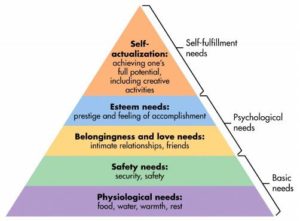
Abraham Maslow was an American psychologist who developed the Hierarchy of Needs Pyramid (pictured). His theory walks through the needs of a person and how once those needs are fulfilled, how our mind can expand to handle a different set of needs, up to the point of Self-Actualization (although before he died he was working on a level above self actualization called, self transcendence). In the picture, the foundation is established with basic physical needs like food and warmth. Each level adds a new dynamic to the ability to live and strive.

What is interesting about this pyramid, is two-fold; 1. We as a species tend to work in an upward direction naturally. 2. An individual (or even a society) can move up and down the pyramid.  For example, lets say you are a tenured college professor. You have a family, a comfortable home and some job security. You are very knowledgeable in your field and colleagues and students come to you for your sound guidance. One Spring, a storm comes through and a tornado destroys your home. Your family is safe, but you no longer have a place to live. Later in the same day, someone comes to you for some of your sound advice. Do you think the advice you give or even the energy around the advice will be of the same substance it would have been two days prior to the storm? Where would your head be?

Maslow discusses when our foundations are shifted in a substantial way, our mind changes to handle the pressing need. A smaller example of this is, the phrase, ‘hangry’.  Often defined as, ‘so hungry you’re angry.’ You typically can recognize when this is occurring in yourself because you recognize the physical feelings of hunger. Once your hunger is satisfied, you are then able to function at a higher level. You might even have experienced a person who lost their job unexpectedly. Think for a moment, how they changed or acted differently when that occurred.

Here’s the next piece. In the situation of the friend losing their job; if they found a job of equal pay or status, did their attitude and demeanor return? Where they once again the person you knew and were familiar with? Did this shift in them happen quickly?

Maslow believed once you ‘level up’ on the pyramid, if a foundational level is affected (job loss, home destroyed, hunger, etc), it is easier for us to return to our highest level of function once the impacted level is resolved. Also, some individuals will never achieve Self Actualization and others may achieve it very easily.

When my coat was taken, I felt as though I was stranded and unable to meet the needs of my schedule, I began to observe myself being very uncomfortable and some of that discomfort was making me feel upset. What level was being impacted the most? Probably Esteem, I had a class I needed to be at, but also, not having access to my home was poking at my security needs. Now, I knew I could get a hold of my husband to let me in the house, but at the moment, I didn’t know where he was or if he would be able to answer the phone. At the same time, the people around me were trying to be gracious with their help.

In yoga, we talk about the yamas, sometimes called the ‘Dont do’ list. The first element of the yamas is ahimsa, the action of non-violence (love in action). Was I going to become violent? Of course not, but what if my words with the other members of my club were, ‘SOMEBODY, stole my coat!’ as opposed to what I actually said, which was, ‘someone grabbed my coat by mistake.’ I knew the person didn’t intentionally take it. I also knew, they were probably going to feel bad knowing they caused another person an inconvenience.

As I moved through this morning’s experience, I kept thinking about how this is my practice in action. All the sun salutations, focusing on breath, the meditation work, they are all lining myself and others up so we may begin to activate these tools during as we encounter sudden shifts in environment.  And even as the solution resolved itself and the end was near, even now as I tell the story, I’m still practicing my yoga. Yoga is a mindful practice, a lifestyle that can extend into a physical one. Not the other way around.

I invite you to love-in-action with me today,
~C